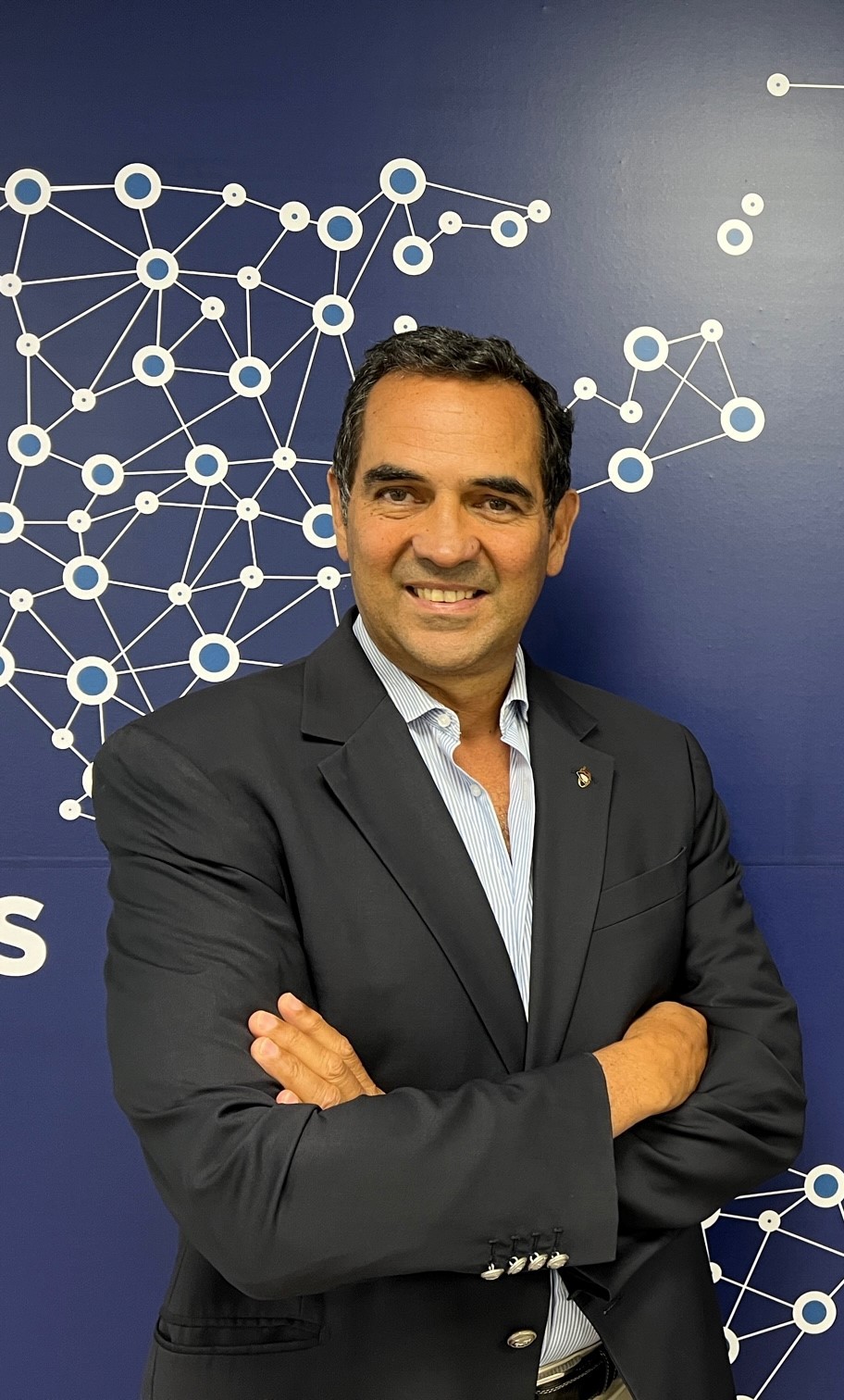
As part of the partnership between the Portuguese Diaspora Council and Jornal de Negócios, this initiative showcases Fernando Braz de Oliveira’s international career, highlighting his professional experience in Cape Verde with Grupo ETE and CV Interilhas, as well as the business opportunities and potential for economic cooperation between Portugal and Cape Verde.
1 – What led you to leave Portugal?
My professional life took me overseas and beyond Portugal’s borders from an early stage. As an officer in the Portuguese Navy and, later, throughout my business career in the maritime sector, I had the privilege of navigating not only the seas but also different geographies, cultures and realities.
When I was invited to take on a new challenge in Cape Verde, I saw it as a natural progression in my career. I was already familiar with Africa, its diversity, its potential and the richness of its human relationships.
The project presented to me, combined with the fact that it was based in Cape Verde, a country with deep historical, cultural and emotional ties to Portugal, made the decision particularly easy.
Looking back, I consider it one of the best decisions I have ever made. Cape Verde welcomed us exceptionally well and allowed me to continue growing professionally while contributing, through my roles at Grupo ETE and CV Interilhas, to projects with a tangible impact and to the country’s economic and social development.
2 – What advantages or disadvantages has being Portuguese brought you?
The main advantage has undoubtedly been the Portuguese language, which is fundamental to building bridges, bringing people together and removing barriers. Being Portuguese allowed me to adapt quickly, integrate naturally and develop a genuine connection with the local culture and way of life.
Throughout my life, I have come to realise that being Portuguese abroad means carrying an identity that readily finds common ground with other peoples and cultures.
3 – What challenges have you had to overcome, and how have you done so?
The greatest challenge for anyone living and working outside Portugal is undoubtedly saudade — the longing for home.
By nature, we are deeply attached to our roots. We value home and remain closely connected to our everyday lives: our families, homes, work, friends, sport and the routines that are often difficult to leave behind.
My professional experience as a Portuguese Navy officer, involving numerous missions away from home, taught me how to deal with this reality. I developed the strategies, habits, routines and discipline that keep me occupied and focused on my objectives.
I learnt that the best way to manage saudade is not to fight it, but to integrate it into our lives. This means managing our daily routines effectively and becoming fully involved in the community that welcomes us, getting to know its people, culture and way of life.
Interestingly, saudade never disappears. Instead, it becomes a quiet strength that reminds us where we come from while giving us the energy to continue building bridges between the place we left behind and the place we have learnt to call home.
4 – What do you admire most about the country where you live?
Cape Verde is an extraordinary country that welcomes us, enriches us and wins our hearts through its morabeza — a word which, like saudade, has no direct translation and must be experienced.
Cape Verde is a small country with a vast ocean and extraordinary people. It is precisely these people who make the country such a genuine place and enrich the lives of everyone fortunate enough to live and work here.
5 – What do you admire most about the company or organisation you work for?
Grupo ETE has the ability to combine 90 years of experience with a forward-looking vision, always with a commitment to sustainable development. It is an organisation that brings together knowledge, expertise and multidisciplinary capabilities with a strong culture of responsibility and value creation.
In Cape Verde, this vision translates into a clear commitment to people, the development of local talent and the enhancement of skills that contribute directly to the country’s sustainable growth. I am particularly proud to work with highly qualified and motivated Cape Verdean teams, whose dedication and professionalism are essential to the results we achieve.
Grupo ETE’s presence in Cape Verde spans strategic areas such as maritime transport, integrated logistics, engineering and maritime services. This enables us to respond to the country’s challenges in an integrated way, putting decades of accumulated experience at the service of economic development and connectivity between the islands.
This is the ‘field of honour’ for those who have served at sea. Now, within this Group, which operates in transport and integrated logistics, that experience allows me to make a distinctive contribution, creating value and supporting Cape Verde’s sustainable development.
6 – What recommendations would you give to Portugal and its business leaders and managers?
I do not feel particularly comfortable offering recommendations to Portugal or to Portuguese business leaders and managers, many of whom are undoubtedly more experienced and competent than I am in numerous areas.
Instead, I would like to share one of the principles that guides my professional life, inspired by the book A Message to Garcia, which has accompanied me for many years and encourages me every day to do more and do better, with responsibility and perseverance. It has taught me to seek solutions rather than problems and not to give up in the face of adversity.
If there is one conviction that the passing years have reinforced, it is that success does not come without hard work, and that luck takes a great deal of work!
7 – In which sectors of the country where you live could Portuguese companies find customers?
Cape Verde is traditionally known for its morabeza, the music of Cesária Évora and its strategic location in the middle of the Atlantic. More recently, it has also become known for the Blue Sharks, the national football team, and the phenomenon of Vozinha, projecting a modern, dynamic and confident image to the world.
Today, Cape Verde is asserting itself as an increasingly visible player on the global stage. It is a stable country, open to investment, with a privileged geostrategic location between Africa, Europe and the Americas. It is emerging as a platform for services, knowledge and innovation, attracting interest and generating countless opportunities for investors.
Tourism remains one of the main drivers of the Cape Verdean economy, but opportunities extend far beyond this sector. I see enormous potential in communications and the digital economy, Earth observation and space technologies, the blue economy, scientific research applied to the oceans, climate-resilient agriculture, drinking water production and energy sustainability, particularly renewable energy.
8 – In which sectors in Portugal might companies from the country where you live be interested in investing?
Cape Verde’s modernisation is reflected in its high levels of digitalisation and its expertise in specialised services. Given their global reach, these services can be exported anywhere in the world through shared service centres.
In this context, I believe there are significant opportunities for partnerships between Cape Verdean and Portuguese companies in areas related to the blue economy, particularly fishing, fish processing and value addition, maritime logistics, port services, applied ocean research and technical training associated with maritime activities.
Rather than simply a relationship between an investor and a market, I see enormous potential for the creation of shared value chains between Portugal and Cape Verde.
9 – What competitive advantage does the country where you live have that could be replicated in Portugal?
Living in Cape Verde has shown me that proximity builds trust, and trust is one of the main drivers of development.
However, there is one characteristic I particularly admire: the resilience of the Cape Verdean people, which supports their ability to compete in an increasingly global environment. In an archipelago with limited resources and constant challenges associated with its island geography, there is an extraordinary capacity to adapt, innovate and overcome difficulties. Here, limitations are not simply obstacles; they are incentives for creativity and the search for new ways to make things happen.
10 – Do you intend to return to Portugal? Why?
Every expatriate has a return ticket! Sooner or later, saudade eventually wins out over the mission.
Nevertheless, my outlook is reshaped every day. With every sunset, I reflect on the journey so far; with every sunrise, I renew my desire to continue contributing, learning and serving.
I never take anything for granted. I approach each new day with the same energy, enthusiasm and determination as I did on the first, always ready for another challenge and another day’s work.
Although I know Portugal will always be waiting for me, I continue to embrace this experience with great enthusiasm and gratitude. Cape Verde has welcomed me exceptionally well, and as long as I feel I can continue to create value, contribute to the country’s development and strengthen relations between Cape Verde and Portugal, I will maintain the same motivation that brought me here.