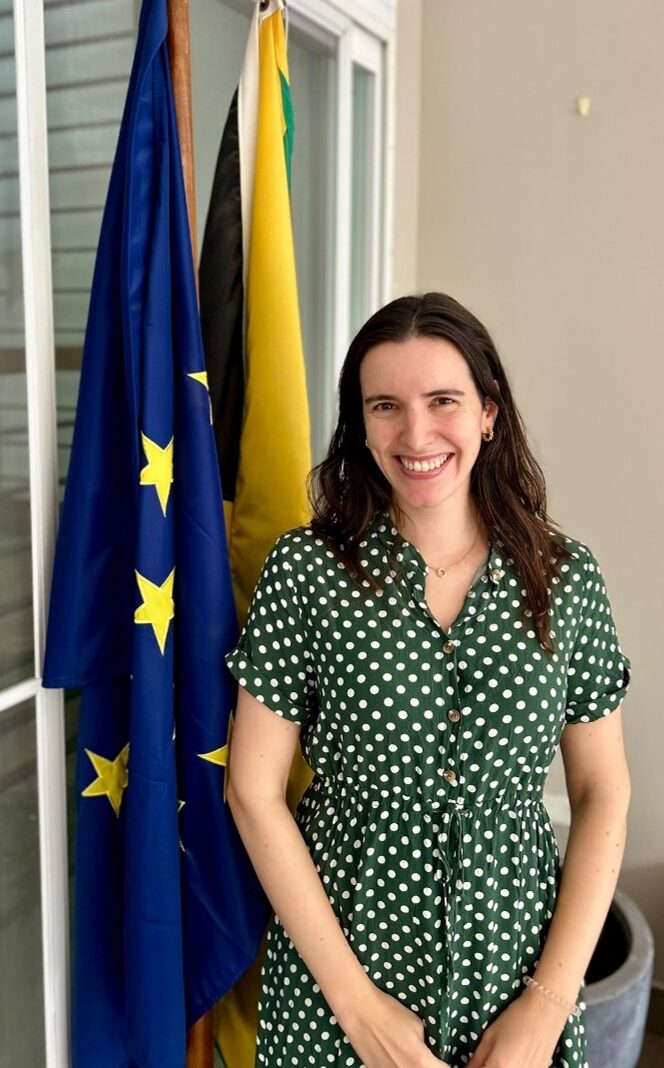
As part of the partnership between the Portuguese Diaspora Council and Jornal de Negócios, this initiative showcases Bárbara Matias’s international career, highlighting her experience in European Union diplomacy and her professional background across different international contexts, as well as the business opportunities between Portugal and Jamaica, particularly in the agri-food, tourism and cultural industries sectors.
1 – What led you to leave Portugal?
I have always been interested in pursuing a career with a strong international dimension. I wanted to discover new environments, explore new horizons and, above all, test my abilities on a global platform. Leaving Portugal was therefore less a decision to “leave” and more a desire to discover what I could achieve beyond my usual surroundings. I have always been particularly drawn to environments where one needs to adapt quickly, navigate different cultures and working practices, and learn from people with different backgrounds and experiences.
I also believe that living abroad forces us out of our comfort zone: we have to build new networks, learn to operate in contexts we are not always familiar with and, often, find solutions to unexpected challenges. Over time, I realised that it is precisely this combination of challenge, learning and exposure to different realities that motivates me most.
2 – What advantages or disadvantages has being Portuguese brought you?
I see a major advantage in being Portuguese abroad: the Portuguese people I meet overseas are, as a rule, extremely capable, hardworking and willing to help. Portuguese networks around the world are also, finally and fortunately, growing, and this is extremely valuable. An informal contact can open a door, answer a question or simply make settling into a new environment easier.
If I had to identify a disadvantage, I would say that coming from a relatively small country sometimes means having a less significant presence in certain international environments compared with other nationalities. In some of the countries where I have lived, other national communities were already well established and organised, which naturally made building contacts and settling in easier. At the same time, this reality ultimately had a positive effect: it forced me to become more independent, accept invitations and take more initiative.
3 – What obstacles have you had to overcome, and how did you do so?
One of the challenges was precisely the lack of a large or well-established local Portuguese network, particularly when compared with those of other nationalities. This means having to build our own network from scratch. There are also much more practical obstacles: when you live far away, returning home is not always easy. For example, travelling between Kosovo and Portugal, and now between Jamaica and Portugal, can turn what seems like a straightforward journey into a real logistical operation due to flight connections. This is also part of the experience of living abroad: we learn to become more adaptable.
4 – What do you admire most about the country where you currently live?
Jamaica is a country exposed to many vulnerabilities, particularly natural disasters. However, it is inspiring to see how this reality coexists with an extraordinary ability to bounce back. There is a youthful spirit, an energy and a positive attitude towards life that can be felt in everyday life. Even after very difficult moments, such as Hurricane Melissa last year, there is a determination to rebuild, move forward and celebrate again. This says a great deal about the resilience of the country and its people.
And, of course, there is also an extraordinary cultural richness: music, gastronomy, art and sport. Jamaica has a very strong identity and an exceptional ability to project its culture far beyond the limitations of being an island.
5 – What do you admire most about the company or organisation you work for?
I owe a great deal – and we all do – to the European Union and the European project. I never take for granted the conditions in which I grew up or the opportunities I have had as an EU citizen. Erasmus, for example, was a transformative experience, as was the opportunity to study and work in different European countries without the restrictions that would exist in other contexts.
Today, working in European Union diplomacy, I particularly admire the way we support partner countries in achieving their development objectives and pursuing their political ambitions. The EU is not merely an economic space; it is a community built on principles, rules and rights. Being able to work with this sense of purpose is truly indescribable.
6 – What recommendations would you give to Portugal and its business leaders and managers?
I would make a very simple recommendation: step outside your comfort zone and build relationships. Make contacts, explore networks and seek to understand other markets. Portugal has excellent companies and professionals, but sometimes I would even say that we are held back by excessive modesty in the way we present ourselves.
Living abroad has taught me that knowledge and contacts multiply when they are put to use and shared. And that, to seize an opportunity, it is often necessary first to have the curiosity to ask the right question. Many opportunities begin with a conversation that, at first, may seem to have no particular purpose.
7 – In which sectors of the country where you live could Portuguese companies find customers?
Jamaica is a market that deserves to be explored much more by Portuguese companies. There is a tendency to view the Caribbean as a group of very small markets with limited economic capacity. Jamaica is different: it has regional influence, a diversified economy and a significant position within the region.
I see opportunities, for example, in the agri-food sector, food and beverages, and tourism. Portuguese products could find an interesting market here.
8 – In which sectors in Portugal might companies from the country where you live be interested in investing?
Music and the cultural industries are perhaps the most obvious examples. Jamaica enjoys an extraordinary cultural presence and has an ability to turn creativity into identity and economic activity.
Gastronomy is another interesting area: Portugal has a very rich food tradition and a gastronomic culture that could be attractive to the Jamaican market.
9 – What competitive advantage does the country where you live have that could be replicated in Portugal?
I would say it is the positive outlook and resilience. As I mentioned, Jamaica has a very particular ability to keep moving forward despite its vulnerability to natural disasters. This attitude towards adversity is a clear advantage, reflected in both economic and social terms.
Portugal also has a tremendous capacity to adapt, but perhaps we could learn from the Jamaican approach of combining resilience with optimism and a great ability to celebrate life.
10 – Do you plan to return to Portugal? Why?
Yes, I would love to return. Portugal will always be home. However, at this stage, I am focused on pursuing my international career as an EU diplomat.
I would certainly like to return, but to enjoy a wonderful retirement alongside my husband. Ultimately, I feel that living abroad changes our relationship with our country of origin. We come to appreciate more deeply what we have, as well as what we can bring back with us from the experiences we have had elsewhere.