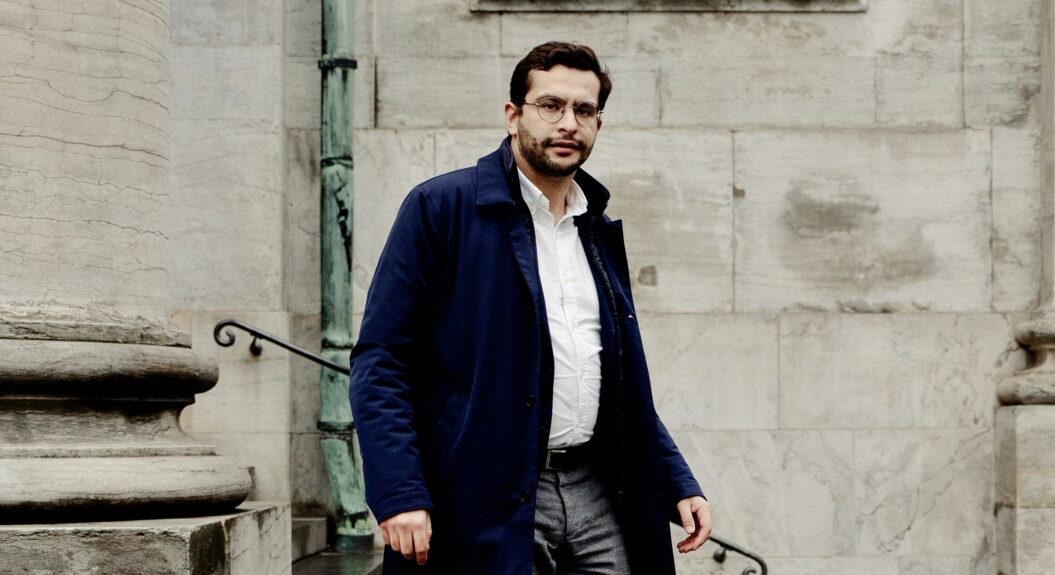
As part of the partnership between the Portuguese Diaspora Council and Jornal de Negócios, David Pereira de Castro, President at SPOT Nordic, shares insights into his personal and professional journey in Denmark, as well as his reflections on Portugal’s economic potential.
1 — What led you to leave Portugal?
I left for a combination of family reasons and professional ambitions. In 2019, personal reasons led me to Copenhagen, after a journey in Portugal that went through Public Administration, the Ministry of Economy and municipal functions. But the change only made sense because Denmark also offered a demanding professional horizon: I did a master’s degree in International Business and Politics at Copenhagen Business School and today I am developing a PhD at the same school, where I also teach. It was a life decision that turned into an opportunity: to learn from the inside how an ecosystem works where science, companies and the State cooperate naturally, and to try to return this learning to Portugal, through SPOT Nordic and what I write about the Portuguese economy.
2 — What advantages or disadvantages did the fact that you are Portuguese bring you?
Being Portuguese has brought me above all advantages. We bring a solid background, linguistic and relational facility and an ability to adapt that is recognized in the Nordic countries, where qualified Portuguese professionals have a good reputation. In a more reserved cultural environment, our openness helps to build bridges and create relationships of trust. The main disadvantage is to leave without networks: social capital is built from scratch and credibility has to be demonstrated, not inherited. And the Portugal brand is still more associated with tourism and lifestyle than with science, engineering and technology, so we all end up doing a little work of representing the country and its real skills.
3 — What obstacles did you have to overcome and how did you do it?
The obstacles were those of almost all emigrants: the language, the cultural codes of a society that is informal in form, but demanding in its implicit rules, and the construction of a professional network in a country where trust is slowly gained. There was also a new beginning: I arrived without contacts and had to rebuild a step-by-step path, with the doubts that this brings. I overcame these barriers with time, study and presence: I invested in qualification, learned the local work culture and helped create platforms, such as SPOT Nordic, which organise the qualified Portuguese community and give it a voice in universities and companies. It is a work that today also connects me to Sweden, Norway and Finland, where, with other Portuguese and in joint initiatives with the Portuguese embassies, we are building the Portuguese network in the Nordic countries. Integration is not an act, it is a process, and it requires consistency and some humility.
4 — What do you admire most about the country where you are?
Trust. Between people, companies and institutions, trust reduces transaction costs, allows for flat hierarchies, real delegation and quick decisions. I also admire pragmatism: problems are discussed based on data and solved by consensus, without dramatization. And I am impressed by the way the country transforms knowledge into value: universities, foundations, pension funds and companies work together to convert science into exports, as seen in wind energy, pharmaceuticals or maritime logistics. All this is based on a balance between work and personal life that, far from reducing productivity, sustains it: a model in which professional demand coexists with respect for each one’s time.
5 — What do you admire most about the company or organization where you are?
Copenhagen Business School connects research, education and society without heavy hierarchies. A young researcher has real autonomy, direct access to top professors and permanent contact with companies and public decision-makers. I appreciate the interdisciplinarity and international openness of the group in which I belong, in which I am developing a PhD in international political economy, with a focus on multinational corporate structures, global wealth chains and greenwashing. And I appreciate the fact that the school takes its public role seriously: the topics I work on are treated as issues of society and not just as academic objects. Teaching here, in areas such as comparative political economy, has been for me a permanent school of rigor and learning.
6 — What recommendations would you give to Portugal and its entrepreneurs and managers?
I would say, with the prudence of someone who observes from a distance, that the essential thing is to distinguish growth from value creation activity. Portugal grows in volume, tourism and employment, but remains fragile in productivity, business scale and position in global value chains. It was this diagnosis that I sought to develop with Paulo Morgado in the book VAB – Valor Agregdo Brando, published by Vida Económica: too large a part of the value created in the country is soft, not very defensible, not very scalable and not very internationalizable. To entrepreneurs and managers, I would suggest gaining scale through capitalization and capital markets, professionalizing management and governance and building defensible competitive advantages, instead of competing for costs. From the State, I would ask for predictability and a serious commitment to a more dynamic capital market, which manages investment and savings mechanisms that guarantee long-term sustainability.
7 — In which sectors of the country where you live could Portuguese companies find customers?
Denmark, but also Sweden and Norway, are demanding but loyal markets: those who enter as qualified suppliers tend to stay. I see opportunities in the wind energy and renewable energy supply chain, where Portuguese metalworking, molds and engineering have the level to compete; in construction and rehabilitation, with a chronic shortage of skilled labor; in information technology and engineering services, given the high cost of local talent; in value-added agri-food, from wine to gourmet products; and in certified supply to the pharmaceutical and medical device industry. The key is to come up with certifications, strict deadlines and a solid technical proposal, not just with price.
8 — In which sectors of Portugal could companies in the country where you live want to invest?
Danish companies are looking for talent, clean energy and stable locations in the European Union, and Portugal has all three. I see potential in renewable energy, including offshore wind, solar and green hydrogen, where Danish operators are world leaders; in the economy of the sea and ports; in engineering, data and digital services centres, taking advantage of Portuguese technical talent; in life sciences, where Denmark has industrial giants and Portugal has clinical and scientific capacity; and in agri-food. To capture this investment, Portugal needs predictable licensing, a robust electricity grid and public interlocutors who respond quickly.
9 — What is the competitive advantage of the country in which you live that could be replicated in Portugal?
I would choose the capitalized pension system. Danish pension funds generate long-term savings that finance companies, infrastructure and innovation, as well as guarantee safer retirements. It is a silent but structural advantage. Portugal, without institutional economies of scale, is dependent on foreign capital and debt, and many of its best companies end up sold early. Gradually creating a capitalization pillar would change the ownership structure of the Portuguese economy in twenty years. It would also replicate the tripartite trust between the state, companies and workers, which allows flexibility with security, and the articulation between universities and industry: none of this requires natural resources, it requires institutional design and patience.
10 — Are you thinking of returning to Portugal? Why?
I have never completely left: I maintain an active connection to Portugal through SPOT Nordic, the Portuguese Diaspora Council and what I write about the Portuguese economy. My personal life is now divided between Portugal and Denmark, and this naturally weighs on the choices. I do not exclude returning, but I think that the right question is not where we live, it is where we add value: at the moment I feel that I am more useful as a bridge between Portugal and the Nordic region, connecting institutions, researchers and companies. If a concrete project arises in which it can make a difference in Portugal, I will consider it seriously. The essential thing is that the country treats the qualified diaspora as a permanent resource, with mechanisms for the circulation of talent, and not just as a nostalgia.