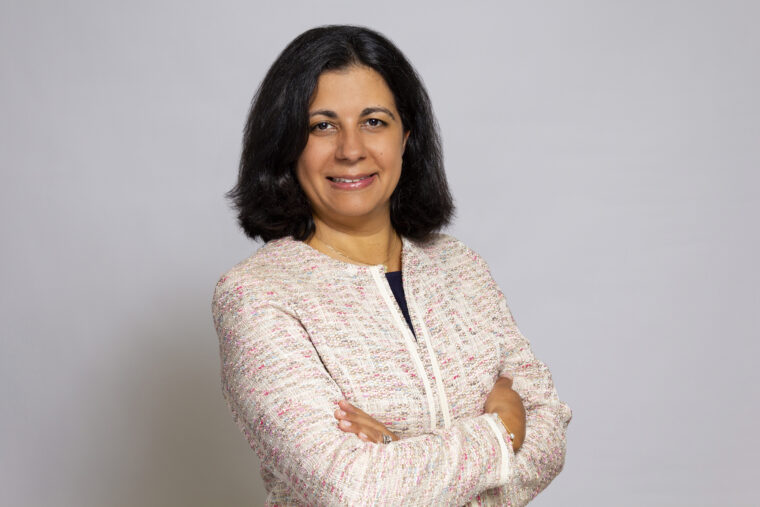
As part of the partnership between the Portuguese Diaspora Council and Jornal de Negócios, Mariana Carriço, Head of Category at L’Oréal Spain and Portugal, shares her journey since leaving Portugal, as well as her perspective on the role of the Portuguese diaspora as a bridge for international business.
1 — What led you to leave Portugal?
The decision to leave Portugal was driven by a professional opportunity: L’Oréal has its epicenter in Paris, where research and product development is based, an area that it has always wanted to explore. In addition, there was also a genuine desire to broaden horizons and get to know other cultures. I had already done Erasmus in Italy and an exchange program in Australia, but I wanted to live abroad again, this time at a professional level.
2 — What advantages or disadvantages did the fact that you are Portuguese bring you?
The advantages are many. The Portuguese have a remarkable ability to adapt to diverse cultural contexts, a natural facility with languages and a spirit of improvisation that allows us to navigate complex situations with agility. We are also recognized as dedicated professionals, with genuine panache.
Disadvantages, I haven’t found any yet. Those who go abroad are, from the outset, willing to work hard, to integrate into the local culture and to try to have a good professional career. With this attitude, there is no disadvantage to being Portuguese.
3 — What obstacles did you have to overcome and how did you do it?
More than obstacles, I prefer to call them integration challenges. The need to learn other languages, to absorb local cultural references, humor, the nuances of everyday life. In Paris I learned that integration is a daily job, made up of humility and willingness to learn, and that getting out of the comfort zone makes us stronger. When I arrived in Madrid, the Iberian proximity made everything more fluid — but humility is always necessary: each culture has its own way of being and working. To this is added a personal challenge: I came with family and children, with less support network nearby. Managing the day-to-day in these conditions is a constant adaptation and a daily exercise of organization and resilience.
4 — What do you admire most about the country where you are?
In Spain, I admire the culture of execution. You spend less time arguing about how and when, you take more risks, and when something doesn’t go well, you don’t judge the mistake — you learn and move on. It is precisely this agility that I realized was at the basis of the high productivity rates. You also feel a more horizontal and less formal work culture — you decide faster, there are fewer barriers between hierarchical levels, and that speeds everything up. But I also admire the way Spaniards enjoy life outside of work. Terraces and restaurants are full every day, and there is a genuine culture of work-life balance that coexists, very naturally, with this orientation towards results.
5 — What do you admire most about the company or organization where you are?
L’Oréal is a company with a great legacy and a portfolio of iconic brands with a connection to consumers around the world. Operating on a truly global scale opens up horizons that you would hardly find in any other context. But what moves me the most — and it’s not a cliché — are the people and the company’s culture. There is a shared passion, a spirit of achievement and a determination that is felt on a daily basis. Despite being a large multinational, there is a sense of family. I’ve made friends for life in this company — and it doesn’t happen by accident.
6 — What recommendations would you give to Portugal and its entrepreneurs and managers?
That they look outward with confidence and without complexes. We are often hostages of a small country syndrome that does not correspond to us — and when we leave, we realize how much Portugal is valued for its history, traditions, culture and people. First, to invest in a more assertive and consistent Portugal brand — not only because of the raw material we have, but because we have the legitimacy to do so. Countries such as Sweden or Denmark have done so, exporting not only products, but an identity, a way of living and thinking that the world recognizes. Second, to bet on niches of excellence: not to compete in volume, but in quality and differentiation. Portugal has already demonstrated this in automotive molds and components, in wine and olive oil, in cork, in footwear and in textiles — the question is to export this logic to other sectors. And finally, leverage the diaspora: the Portuguese abroad are a network of contacts and market knowledge that is still very underused. A Portuguese expatriate often manages to open doors that formal channels can hardly reach — and there is a huge desire to do so. That is the spirit of the Diaspora Council.
7 — In which sectors of the country where you live could Portuguese companies find customers?
In Spain, Portuguese brands already have a reputation for solid quality, especially in the textile and manufacturing area — fashion, footwear, home textiles and ceramics. The phenomenon of Portuguese content creators has also been bringing the two markets closer together in an organic way, especially in fashion and beauty. But where I see growing potential is in gastronomy. The pastel de nata is already a phenomenon in Spain and brands such as Manteigaria and O Melhor Croissant da Minha Rua are Portuguese concepts that have successfully crossed the border. And Portuguese artisanal preserves are today a gourmet product highly valued internationally. Portugal exports not only products, but concepts and experiences with its own identity, and there is still much to explore in this regard.
8 — In which sectors of Portugal could companies in the country where you live want to invest?
Portugal has attractive conditions for Spanish investment in various sectors. In retail, this investment is already a visible reality: Mercadona has expanded to Portugal with a growing presence, and brands such as Primor and Druni are also conquering the Portuguese market — a clear sign of confidence in the country’s potential. In the audiovisual industry, Portugal combines creative talent, exceptional climate and competitive production costs — an equation that is already attracting international productions and that deserves more assertive recruitment policies. In technology, the quality of Portuguese engineers and IT professionals is increasingly recognized, positioning Portugal as a natural destination for innovation and development hubs. And in education and higher education, universities such as Nova SBE and Católica Lisbon are examples of institutions with a clear strategy to attract students and international partners, and that demonstrate Portugal’s potential in this sector.
9 — What is the competitive advantage of the country in which you live that could be replicated in Portugal?
The infrastructure. In Madrid, the city works: a large-capacity and well-located airport, efficient road access, one of the largest metro networks in Europe and a high-speed rail network that connects the entire country. But what impresses me most is not Madrid itself — it’s the way Spain has managed to develop multiple economic and cultural hubs that attract talent and distribute wealth across the territory. In Portugal, a national plan with this ambition is needed: to spread investment, create conditions for young people and companies to settle in different regions, and ensure that the country’s growth is not concentrated in a single point. This also implies rethinking the excessive dependence on tourism — a sector that is structurally unproductive, without the capacity for automation, very much based on low wages. Portugal deserves to invest in sectors that generate more added value and better living conditions for those who live here.
10 — Are you thinking of returning to Portugal? Why?
Yes, in the medium and long term, probably. Portugal is always on the horizon. It’s hard to be away from family and friends — and when you’re away you realize how much you took for granted. It was while living abroad that I began to truly listen to and appreciate Fado — perhaps because it is the most Portuguese expression of saudade. The sea, the climate, the gastronomy, the people — there is a thread that always connects us to our origins. Spain, due to its Iberian proximity, softens this distance, but I believe that, at the right time, and when life and career allow it, Portugal will be home again.